
Research Projects
Broadly, my lab is focused on exploring the evolution and ecology of non-human primate and human sensory systems using molecular, psychophysical, behavioral, and field ecology toolkits. I currently am engaged in several major research projects and programs.

Molecular, Anatomical, and Behavioral Ecology of Discriminative Touch in Primates
With Magda Muchlinski (Oregon Health and Science University) and Amanda Melin (University of Calgary), my lab is investigating the variation and evolution of discriminative touch across primates as part of a project funded by the National Science Foundation. We are exploring how locomotion, foraging strategy, diet, and tool use have shaped gene expression and mechanoreceptor anatomy in primate, human, and non-primate mammal hands and feet.
Our previous work found that monkey species significantly differ in how frequently they use touch to investigate fruit and in anatomical proxies of manual dexterity. Currrently, we are using traditional histology methods to explore variation in the densities of different mechanoreceptors across body regions, between individuals, and between species, and combining these results with transcriptomics and spatial transcriptomics to investigate potential genes associated with mechanoreceptor densities. We are collaborating with several research institutes and organizations on this project, including Kids Saving the Rainforest wildlife sanctuary in Costa Rica and the Caribbean Primate Research Center.
We are also looking for field primatology collaborators interested in incorporating how manual touch is used during foraging into their species!
Recently, we investigated mechanoreceptor densities in macaque fingertips and found both age-related changes and a relationship with dermatoglyph features: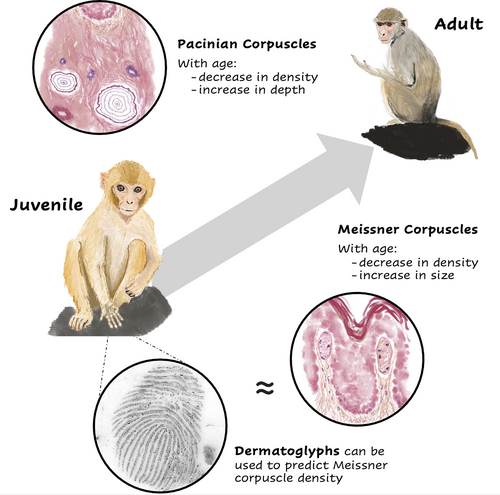
Covarrubias, B. V., Kamminga, J. M., Muchlinski, M. N., Munds, R. A., Villero Núñez, V., Bauman Surratt, S., Cayo Biobank Research Unit, Martinez, M. I., Montague, M. J., Higham, J. P., Melin, A. D., & Veilleux, C. C. (2026). Investigating mechanoreceptor variability and morphometric proxies in Rhesus macaques: Implications for primate precision touch studies. The Anatomical Record, 309(4), 1005–1024. https://doi.org/10.1002/ar.25587
Aging and the Senses
My lab is also currently exploring how aging affects sensory function, sensory anatomy, and sensory gene expression. As we age, our sensory function tends to decline, but how this anatomy changes and the mechanisms causing these changes are less well understood. We are collaborating with my colleagues at Midwestern (Meg Hall, Chriss Heesy), the Melin lab at the University of Calgary, James Higham at NYU, Mike Montague at the University of Pennsylvania, Noah Snyder-Mackler at Arizona State University, and the Caribbean Primate Research Station to investigate sensory aging in a non-human primate model (Macaca mulatta).
For a broader look at what animal models can contribute to sensory aging research, see our review in GeroScience.

Ecology and Evolution of Primate Vision and Taste
One of my long-term research program is focused on investigating how ecological factors — e.g., diet, activity pattern, and habitat — influence interspecific variation in primate visual and taste systems, often using nonprimate mammals in a comparative context.
For example, how do habitat differences in light environments influence the loss of functional color vision in some nocturnal primate lineages? How do foraging strategy, diet, and activity pattern influence interspecific variation in visual acuity (in strepsirrhines and across mammals), eye morphology, color vision (evolution of polymorphic trichromacy or retention of dichromacy), or taste? Conversely, how does intraspecific variation in color vision influence reproductive success and feeding behavior in polymorphic trichromat species like sifaka (Propithecus verreauxi)?